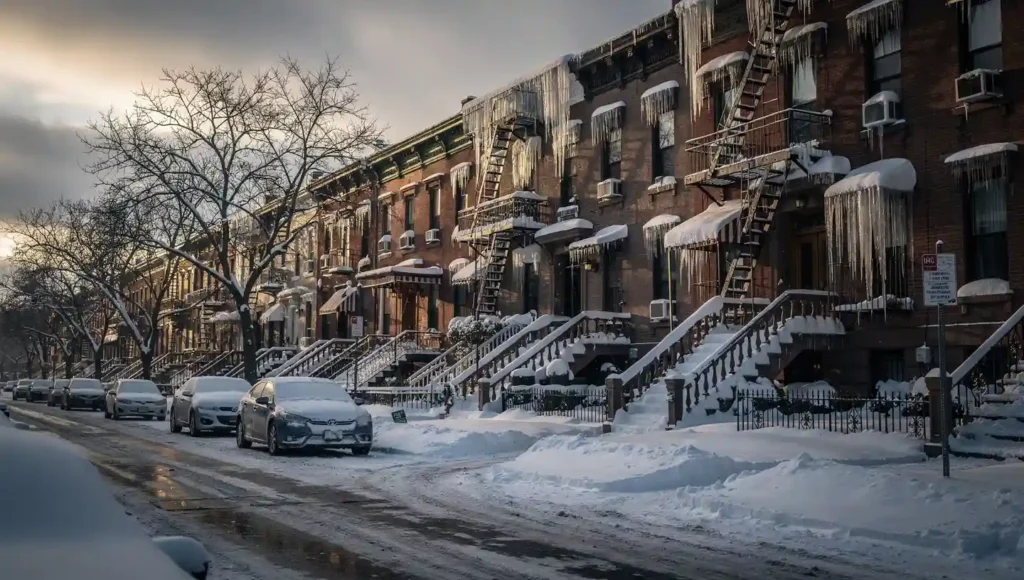
If you own a home in New York — whether it’s a Brooklyn brownstone, a Long Island colonial, or an upstate farmhouse — homeowners insurance in New York is not optional. Your mortgage lender requires it, and given the state’s unique combination of coastal storms, harsh winters, aging infrastructure, and dense urban risks, the right policy can be the difference between financial recovery and financial ruin.
Yet millions of New York homeowners are either overpaying for coverage they don’t fully understand, or underinsured for risks that are increasingly common — from sewer backups in pre-war NYC buildings to nor’easter flooding along Long Island’s south shore.
This complete 2026 guide gives you everything you need: real average rates by company and location, a clear breakdown of what standard policies cover (and what they don’t), the latest legislative changes affecting New York homeowners, and a step-by-step strategy for lowering your premium without sacrificing protection.
📋 Table of Contents
- Average Homeowners Insurance Cost in New York 2026
- Best Home Insurance Companies in New York 2026
- What Does Homeowners Insurance Cover in New York?
- Flood Insurance in New York: What You Must Know
- Water Damage & Sewer Line Coverage
- Coastal Homeowners Insurance in New York
- Rates by City & Region
- 7 Proven Ways to Lower Your Premium
- 2026 Legislative Changes Affecting NY Homeowners
- Frequently Asked Questions
Average Homeowners Insurance Cost in New York 2026
New York homeowners pay below the national average for home insurance — a fact that surprises many people, given the state’s high cost of living. According to data from Bankrate, NerdWallet, and MoneyGeek — cross-referenced and compiled for this guide — here are the current benchmarks:
Rates vary significantly by coverage level, location, and company. A $100K dwelling policy averages around $805/year, while a $1 million high-value home runs $6,129/year or more. Here’s how rates scale with coverage:
| Dwelling Coverage | Avg. Annual Premium (NY) | Avg. Monthly | vs. National Avg. |
|---|---|---|---|
| $100,000 | $805 | $67 | 63% cheaper |
| $250,000 | $1,554 | $129 | 38% cheaper |
| $300,000 | $1,860 | $155 | 23% cheaper |
| $500,000 | $2,100 | $175 | 16% cheaper |
| $1,000,000 | $6,129 | $511 | Varies widely |
⚡ Why Is New York Cheaper Than Average? Despite its reputation for high costs, New York benefits from 546 domestic insurers competing for your business (per NAIC data), strict post-Hurricane Sandy building codes that reduce claim severity, and a large population that spreads administrative costs. However, if you live in a coastal zone or flood-prone area, your rates can be significantly higher than the state average.
Best Home Insurance Companies in New York 2026
Not all insurers are equal in New York. Based on pricing data from Quadrant Information Services, J.D. Power customer satisfaction scores, AM Best financial strength ratings, and NAIC complaint indices, here are the top companies for 2026:
| Company | Avg. Annual Rate (NY) | Best For | AM Best Rating | Notable Feature |
|---|---|---|---|---|
| State Farm | $980/yr | Budget-conscious homeowners | A++ | Lowest rates statewide; strong agent network |
| American Family | $901–$1,093/yr | Overall value | A | Cheapest for $300K dwelling; generous discounts |
| NYCM Insurance | $1,260–$1,340/yr | NYC & regional homeowners | A | Local expertise; retiree & work-from-home discounts |
| Travelers | $1,260–$1,400/yr | Green & eco-conscious homes | A++ | LEED green home discount (up to 5%); strong coastal underwriting |
| Chubb | $2,200–$2,753/yr | High-value & luxury homes | A++ | Lowest complaint rate in NY; guaranteed replacement cost; free home appraisal |
| Nationwide | ~$1,400/yr | Bundlers (home + auto) | A+ | 2025 Bankrate Award for Best Bundling; gated community discounts |
| Allstate | $1,931–$2,217/yr | First-time homeowners | A+ | 2025 Bankrate Award Best for First-Time Homeowners; Claim RateGuard |
| Farmers | $1,329–$1,400/yr | Older homes | A | Best coverage options; strongest for pre-war & historic properties |
💡 Pro Tip: The cheapest company statewide may not be the cheapest for your specific property. State Farm leads in Brooklyn and East Meadow, Main Street America leads in Albany and Buffalo, and Farmers is best in Yonkers. Always compare at least three quotes before choosing — and check with the New York State Department of Financial Services for complaint records on any company you’re considering.
What Does Homeowners Insurance Cover in New York?
Most New York homeowners purchase a standard HO-3 policy — the most common form of home insurance in the country. Here’s exactly what it covers and what it excludes:
✅ Typically Covered
- Fire and smoke damage
- Windstorm and hail damage
- Burst pipes and sudden water damage
- Theft and vandalism
- Lightning strikes
- Falling objects (trees, ice)
- Personal liability (injuries on your property)
- Additional living expenses if home is uninhabitable
- Personal property (furniture, electronics, clothing)
- Detached structures (garage, fence)
❌ NOT Covered (standard policy)
- Flood damage from rising water
- Storm surge and coastal flooding
- Sewer or drain backup (requires add-on)
- Underground service line damage (requires add-on)
- Earthquake damage
- Gradual water damage / maintenance neglect
- Mold from long-term moisture
- Pest infestations (termites, bed bugs)
- Normal wear and tear
- Intentional damage
Key Policy Components Explained
- Dwelling Coverage (Coverage A): Pays to repair or rebuild your home’s structure. Set this to your home’s rebuild cost — not its market value. NYC labor costs mean rebuild costs often exceed purchase price.
- Personal Property (Coverage C): Covers belongings inside your home. Standard limits are 50–70% of dwelling coverage. Consider a scheduled endorsement for high-value items (jewelry, art, electronics).
- Liability (Coverage E): Covers legal and medical costs if someone is injured on your property. Standard policies offer $100,000 — but $300,000 is recommended in high-litigation states like New York.
- Loss of Use (Coverage D): Pays for hotel or temporary housing if your home becomes uninhabitable. Given NYC hotel costs ($300+/night), ensure this limit is at least 20–30% of your dwelling coverage.
Flood Insurance in New York: What You Must Know
This is the single most important gap in New York homeowners insurance — and one that caught tens of thousands of homeowners off guard during Superstorm Sandy in 2012 and the Blizzard of 2026, which buried parts of Staten Island under 30 inches and triggered coastal flooding across Long Island, the Rockaways, and Southern Westchester.
⚠️ Critical Warning: Your standard homeowners insurance policy does NOT cover flood damage. Not a single dollar. This applies to storm surge, rising groundwater, sewer overflow from flooding, and any water that enters your home from outside. This is true regardless of your insurance company or policy tier.
The National Flood Insurance Program (NFIP)
The primary source of flood coverage in New York is the FEMA National Flood Insurance Program (NFIP). Key facts for 2026:
- Average flood insurance premium: approximately $700/year (per NY Department of Financial Services)
- Maximum building coverage through NFIP: $250,000 for a single-family home
- Maximum contents coverage: $100,000
- All 62 New York counties are prone to flooding and experience a flood event at least once every seven years
- Flood policies have a 30-day waiting period before they take effect — you cannot buy coverage during a storm and have it apply to current damage
- The NFIP authorization is set to expire September 30, 2026 — Congress is actively debating reauthorization
- If you’re in a FEMA-designated Special Flood Hazard Area (SFHA) with a federally-backed mortgage, flood insurance is legally required
Private Flood Insurance
Private flood insurance has expanded significantly in New York and can offer advantages over NFIP:
- Coverage limits above $250,000 for high-value homes
- Shorter waiting periods (some as little as 10–14 days)
- Broader coverage options including basement contents and living expense coverage
- Sometimes cheaper than NFIP for lower-risk properties
✅ Action Item: Check your FEMA flood zone status at FloodSmart.gov. Even if you’re not in a high-risk zone, consider a flood policy — nearly one-third of all NFIP claims come from outside designated high-risk flood areas.
Water Damage & Sewer Line Coverage in New York
After flood coverage, water damage and sewer line replacement are the most misunderstood gaps in New York homeowners insurance — and the most common source of denied claims.
What Standard Policies Cover vs. Exclude
| Water Event | Covered by Standard HO-3? | Solution |
|---|---|---|
| Burst pipe (sudden freeze) | ✅ Yes | Standard policy |
| Appliance leak (sudden) | ✅ Yes | Standard policy |
| Roof leak (storm-caused) | ✅ Yes | Standard policy |
| Gradual pipe leak / slow drip | ❌ No — maintenance issue | Prevention only |
| Sewer backup into home | ❌ No | Water Backup Endorsement ($50–$100/yr) |
| Underground sewer line failure | ❌ No | Service Line Coverage ($30–$80/yr) |
| Flooding from outside | ❌ No | Separate Flood Insurance policy |
Why Sewer Coverage Is Critical in New York
New York City’s sewer infrastructure dates back in some areas to the late 1800s. Pre-war brownstones in Brooklyn, Harlem, and the Bronx are especially vulnerable to sewer line failures that can cost $15,000–$30,000 to repair out of pocket. Yet a Service Line endorsement typically adds only $30–$80 per year to your premium — providing $10,000–$20,000 in coverage.
When reviewing your policy, look specifically for these endorsements and add them if missing:
- “Water Backup Coverage” — covers sewer/drain backup inside your home
- “Service Line Endorsement” — covers underground pipes on your property
- “Extended Water Protection” — broader water damage coverage
Coastal Homeowners Insurance in New York
If your home is located on or near Long Island, Staten Island, the Rockaways, South Shore communities, or the Hudson River waterfront — you face a distinct set of insurance challenges that standard policies simply aren’t designed to address.
Unique Coastal Risks in New York
- Storm surge and coastal flooding — not covered by standard policies
- Hurricane wind damage — covered by standard policies, but subject to separate hurricane deductibles in some coastal policies
- Coastal erosion — generally not covered; considered gradual damage
- Nor’easters — the Blizzard of 2026 caused widespread damage across coastal NY, with claims for collapsed roofs, burst pipes, ice dams, and flooding
What Coastal NY Homeowners Actually Need
- Standard HO-3 homeowners policy (for wind, fire, theft, liability)
- Separate flood insurance through NFIP or private insurer
- Water backup/sewer endorsement
- Consider an umbrella liability policy ($1M–$2M) — especially in litigious NYC-area communities
⚡ New in 2026: Governor Hochul signed legislation allowing parametric insurance policies for weather-related events — a new type of coverage that pays out automatically when a specific weather trigger occurs (like wind speeds above a certain threshold), without requiring a traditional claims investigation. This is especially valuable for coastal homeowners facing increasingly severe nor’easters. Ask your insurer if parametric options are available in your area.
New York’s C-MAP program (Coastal Market Assistance Program) helps homeowners in high-risk coastal areas who can’t find coverage in the regular market. The NY Department of Financial Services also expanded access to this program in 2026.
Homeowners Insurance Rates by City & Region in New York
Location is one of the biggest drivers of your premium. Here’s how rates vary across the state based on available 2026 data:
7 Proven Ways to Lower Your Homeowners Insurance Premium in New York
Rates have risen 13% over the past three years in New York — but you’re not powerless. Here are seven strategies that can meaningfully reduce your annual premium:
Bundle Home and Auto Insurance
Combining your home and auto coverage with the same carrier can save 10–25% on both policies. Bundling saves an average of $254/year in New York. Nationwide won the 2025 Bankrate Award specifically for bundling value. If you’re shopping for car insurance in Florida or car insurance in Texas as well, cross-state bundling options may be available through national carriers.
Raise Your Deductible Strategically
Increasing your deductible from $1,000 to $2,500 can reduce your annual premium by 12–20% — particularly in coastal ZIP codes. Only do this if you have sufficient emergency savings to cover the higher deductible in case of a claim.
Install Smart Home Safety Devices
New York insurers reward proactive risk reduction. Discounts are available for: smart water leak detectors, automatic water shut-off valves, monitored security systems, smoke and CO detectors, and storm-resistant or impact-resistant roofing. Installing a fire alarm can save an average of $120/year in New York.
Improve Your Credit Score
New York allows insurers to use credit-based insurance scores. Homeowners with excellent credit pay an average of $1,529/year versus $3,669/year for those with poor credit — a $2,140 annual difference. Pay bills on time, reduce revolving debt, and dispute any errors on your credit report.
Buy New Construction (or Renovate Key Systems)
New construction in New York averages $773/year cheaper to insure than older homes. If you own an older home, updating your roof, electrical system, plumbing, or HVAC can trigger meaningful premium reductions. Notify your insurer after any major renovation.
Avoid Small Claims — Use Insurance for Major Losses Only
Filing multiple claims within three years triggers rate increases. Use your homeowners insurance for significant losses — not minor repairs you can afford out of pocket. A single small claim can increase your premium by 10–40% at renewal.
Shop and Compare Every 1–2 Years
Loyalty doesn’t always pay in insurance. The gap between New York’s cheapest provider (State Farm at ~$980) and most expensive major insurer (Allstate at ~$2,217) for the same home is $1,237/year. Get at least three quotes annually and consider using an independent broker who can compare multiple carriers at once.
2026 Legislative Changes Affecting New York Homeowners
New York’s insurance market is undergoing significant changes in 2026. Here’s what you need to know:
Governor Hochul’s Insurance Accountability Proposal
In early 2026, Governor Hochul announced a proposal requiring insurance companies with at least two years of outsized profit margins to either lower costs or formally justify their pricing to the state. This follows a 2025 State Senate investigation into premium increases and insurer profitability. If enacted, New York homeowners could see rate pressure ease in 2026–2027.
Parametric Insurance Legislation
New legislation signed by Governor Hochul now allows parametric insurance policies in New York — policies that pay out automatically when specific weather events exceed defined thresholds (e.g., wind speeds, precipitation levels), without requiring traditional damage assessment. This is a major development for coastal homeowners tired of claim disputes after storms.
Expanded C-MAP Access
New York’s Coastal Market Assistance Program (C-MAP) — designed for homeowners who can’t find coverage in the standard market — has expanded access in 2026, making it easier for Long Island and Staten Island homeowners in high-risk zones to obtain coverage.
NFIP Reauthorization Deadline: September 30, 2026
The National Flood Insurance Program authorization expires September 30, 2026. Congress is debating long-term reauthorization, including provisions to cap annual premium increases and improve affordability. If you rely on NFIP flood coverage, monitor this closely — lapses in NFIP authorization have disrupted home sales and refinancings in the past.
New York Building Code Enhancements (Post-Sandy)
New York’s post-Hurricane Sandy building code reforms continue to benefit homeowners through lower insurance rates. Homes built to enhanced wind resistance, flood mitigation, and fire safety standards sustain less damage during covered events — and insurers reward this with lower premiums.
Frequently Asked Questions: Homeowners Insurance New York
New York State law does not mandate homeowners insurance. However, your mortgage lender will require it as a condition of your loan — and without it, you’d be personally responsible for the full cost of any damage to your home. Given New York’s risks (coastal storms, severe winters, urban hazards), having coverage is essential regardless of legal requirements.
No. Standard homeowners insurance does not cover flood damage from any source — storm surge, rising rivers, heavy rainfall overflow, or coastal flooding. You need a separate flood insurance policy through the NFIP or a private insurer. Remember: flood policies have a 30-day waiting period before they take effect.
Your dwelling coverage should equal your home’s rebuild cost — not its market value or purchase price. In New York City especially, rebuild costs often exceed market value due to expensive labor, strict building codes, and supply chain costs for older materials. The median rebuilding cost for New York homes is $445,760 (per First Street data). Ask your insurer for a replacement cost estimate or use a rebuild cost calculator.
Based on 2026 rate data, State Farm offers the lowest average rates statewide at approximately $980/year for $250,000 in dwelling coverage. American Family ($901–$1,093) and NYCM Insurance ($1,260) are also among the most affordable. However, rates vary by ZIP code, home age, and coverage level — the cheapest company in your specific area may differ.
Not by default. Standard HO-3 policies exclude sewer and drain backup damage. However, you can add a Water Backup Endorsement for approximately $50–$100/year, which provides $10,000–$25,000 in coverage for sewer/drain backup damage. For older homes — especially NYC brownstones with aging sewer connections — this endorsement is strongly recommended.
Several factors contribute: New York has 546 competing domestic insurers that drive down prices; post-Sandy building codes have reduced claim severity; and New York’s climate, while harsh, doesn’t face the catastrophic wildfire or tornado risks seen in states like California, Oklahoma, or Florida. However, coastal and NYC-area homeowners often pay above the state average due to storm and urban risk factors.
If standard market insurers decline to cover your coastal New York home, you have options:
- New York Property Insurance Underwriting Association (NYPIUA) — the state’s insurer of last resort for high-risk properties
- Coastal Market Assistance Program (C-MAP) — expanded in 2026 to help more coastal homeowners find coverage
- Private surplus lines insurers — specialize in hard-to-insure properties
- Contact the NY Department of Financial Services for guidance and insurer complaint records
Your homeowners policy does not cover vehicle accidents — that’s handled by your auto insurance. However, if an accident happens on your property (e.g., in your driveway), your homeowners liability coverage may apply for injuries to others. For vehicle-related accidents on public roads, see our comprehensive guide on when to hire a car accident lawyer — understanding both your auto and home coverage is essential for full financial protection.
Final Thoughts: Protect Your Biggest Investment
Homeowners insurance in New York is not a one-size-fits-all product. A Manhattan co-op owner has completely different needs than a Long Island coastal homeowner or an upstate farmhouse owner — and the right policy reflects that.
The key takeaways for 2026: the state average of $1,554/year is well below the national average, but your rate depends heavily on where you live and what coverage you choose. Never skip flood insurance if you’re near water. Add a sewer backup endorsement if you own an older home. Bundle with auto to maximize discounts. And compare at least three quotes every year — the difference between the cheapest and most expensive major insurer in New York is over $1,200/year for the same home.
Review your policy before storm season. The time to act is now — not after the next nor’easter.
🔗 More Insurance Guides on Insur0x
Protecting your home is one piece of the puzzle. Make sure you’re fully covered across all your insurance needs: