Updated: March 2026 · 9 min read
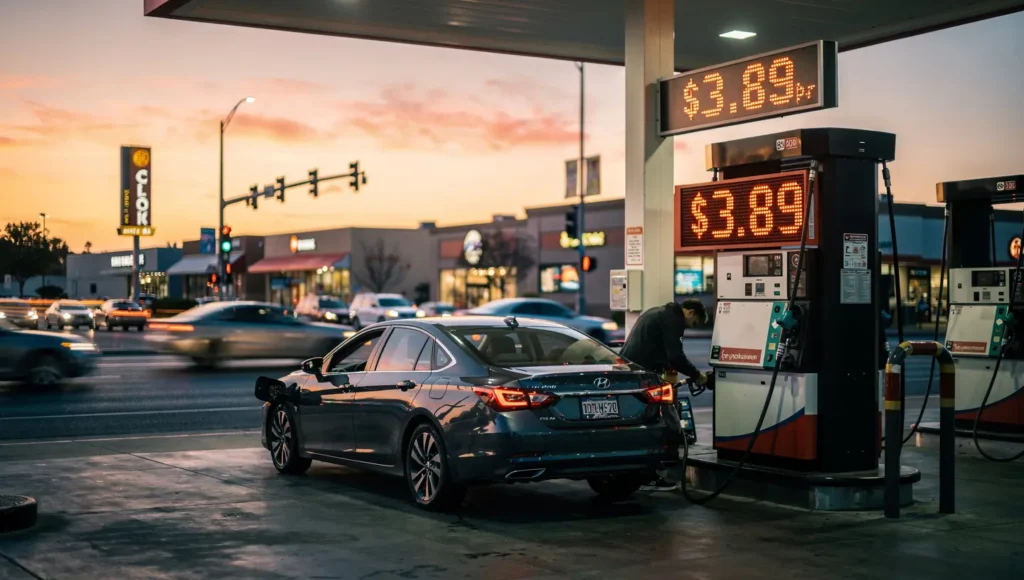
If you’ve pulled up to a gas station recently and felt your stomach drop, you’re not alone. Gas prices in the United States have surged dramatically in early 2026 — and the cause isn’t just seasonal. A military conflict halfway around the world is directly hitting your wallet at the pump. But here’s what most drivers don’t realize: rising gas prices don’t just hurt your fuel budget — they can also push your car insurance rates higher.
In this guide, we break down exactly what’s happening, where prices are headed, and the smartest moves you can make right now to protect your finances.
What Triggered the 2026 Gas Price Surge?
On February 28, 2026, the United States and Israel launched coordinated military strikes on Iran — an event that almost immediately sent shockwaves through global energy markets. The conflict, now widely referred to as the Iran War, disrupted the Strait of Hormuz, the narrow waterway through which roughly 20% of the world’s oil supply flows every day.
The result was swift and severe:
- Crude oil prices jumped from around $67 per barrel before the strikes to over $110 per barrel within days — levels not seen since 2022.
- Shipping companies like Maersk suspended all vessel crossings through the Strait.
- Maritime insurers began canceling war-risk policies for ships in the region, further strangling supply.
According to the Center for American Progress, in just the first week after the U.S. bombed Iran, the average price of gasoline in the United States increased 48 cents per gallon. That’s not a slow seasonal creep — that’s a shock.
Gas Prices by the Numbers: Where Things Stand Right Now
Here’s a snapshot of current gas prices across the U.S., based on AAA and GasBuddy data from early March 2026:
| Location | Average Price (Regular) | Change Since Feb 28 |
|---|---|---|
| National Average | $3.54 – $3.63 / gallon | ↑ ~21% |
| California | $4.81 – $5.34 / gallon | ↑ 12%+ (weekly) |
| Washington State | $4.44 / gallon | ↑ Significant |
| Texas | $2.87 / gallon | ↑ Moderate |
| Oklahoma | $2.79 / gallon | Lowest in the nation |
| Louisiana | $3.04 – $3.20 / gallon | ↑ But below average |
Sources: AAA, GasBuddy, PBS NewsHour — March 2026
For context, the highest gas prices ever recorded in the U.S. were in June 2022, when the national average hit $5.034 per gallon following Russia’s invasion of Ukraine. Analysts are watching closely to see if the Iran conflict pushes us anywhere near that level.
What Do Experts Forecast for Gas Prices?
This is the question everyone is asking — and the honest answer is: it depends on how long the conflict lasts.
“If oil prices stay near current levels of $100 per barrel, gasoline will be closing in on $4 a gallon by next week. Inflation will quickly accelerate, cutting into consumers’ purchasing power.” — Mark Zandi, Chief Economist, Moody’s Analytics (via CNBC)
Gregory Brew, a senior analyst at the Eurasia Group, projects that the U.S. could see $3.50 to $4.00 gasoline in the near term, with diesel potentially hitting $5.00 per gallon this week.
Goldman Sachs warned in an analyst note that if higher oil prices persist, U.S. inflation could rise from 2.4% to 3% by the end of 2026.
Meanwhile, AAA notes that gas prices typically peak in mid-April during normal years due to seasonal demand — meaning this year’s war-driven spike is compounding an already predictable seasonal rise.
Best-case scenario: The conflict ends quickly, the Strait of Hormuz reopens, and prices moderate by late spring.
Worst-case scenario: Prolonged conflict keeps Brent crude above $100/barrel and pushes the national average above $4.50 by summer.
So What Does This Have to Do With Your Car Insurance?
Great question — and this is where most drivers get caught off guard.
Car insurance and gas prices are more connected than you might think. Here’s how rising fuel costs ripple into your insurance premiums:
1. Higher Repair Costs = Higher Premiums
Oil is a key ingredient in plastics, rubber, and synthetic materials used in vehicle parts. When oil prices spike, the cost of auto parts and repairs goes up too. Insurance companies base your premiums partly on what it would cost to repair or replace your car after a claim. When repair costs rise, insurers adjust rates to keep up.
According to InsuredBetter, the cost of vehicle repairs and maintenance already increased by more than 36% between 2021 and 2025. An oil price shock on top of that trend could push repair costs — and eventually premiums — even higher.
2. Shipping and Supply Chain Disruptions
Fuel costs account for 50% to 60% of shipping companies’ total operating costs, according to Patrick Penfield, a supply chain professor at Syracuse University. When those costs spike, auto parts take longer and cost more to ship. That means higher repair bills, longer wait times, and ultimately more expensive insurance claims.
3. Inflation Pressures the Entire Insurance Market
Rising oil prices fuel broader inflation. And inflation has been the #1 driver of car insurance premium increases in recent years. According to the Bureau of Labor Statistics, auto insurance premiums already rose more than 64% between 2020 and 2025 — far outpacing overall inflation of 25% in the same period.
4. But There’s a Silver Lining: People Drive Less
Here’s something interesting: when gas prices surge, many Americans cut back on driving. Fewer miles driven = fewer accidents = fewer insurance claims. This dynamic can actually put downward pressure on premiums — especially for drivers enrolled in usage-based insurance (UBI) programs that track mileage.
Where Were Car Insurance Rates Heading Before the War?
It’s worth noting that before the Iran conflict disrupted everything, 2026 was shaping up to be a rare year of relief for car insurance customers.
- According to ValuePenguin, the average cost of full coverage car insurance in 2026 was $208 per month ($2,496/year) — with a projected increase of less than 1%.
- Insurify projected a stable market in 2026, forecasting just a 1% increase in average annual full coverage premiums — compared to increases of 11.57% in 2023, 17.13% in 2024, and 7.56% in 2025.
- State Farm, the largest auto insurer in the U.S., was actually expected to decrease rates by around 4% for renewing customers.
The Iran war is a wildcard that could disrupt all of these projections — particularly if oil prices stay elevated for months, pushing repair costs and inflation higher than insurers anticipated when they filed their 2026 rate plans.
Most Expensive States for Car Insurance in 2026
If you live in one of these states, you’re already paying a premium — and the current oil shock could make things worse:
| State | Average Monthly Premium (Full Coverage) |
|---|---|
| Nevada | $335 / month |
| Louisiana | $327 / month |
| Florida | $311 / month |
| Connecticut | $300+ / month |
| California | $270+ / month (and rising) |
Source: ValuePenguin State of Auto Insurance 2026
On the flip side, drivers in Vermont ($128/month), Maine ($129/month), and Wyoming ($131/month) are paying the least — and are somewhat more insulated from regional pricing pressures.
5 Smart Steps to Protect Your Wallet Right Now
Whether gas stays elevated for weeks or months, here’s what you can do today:
1. Compare Your Car Insurance Rates Immediately
Many drivers are overpaying without realizing it. Use comparison tools to see if a competing insurer offers better rates. Five of the 10 largest car insurance companies are expected to lower rates in 2026 — you may be able to switch and save right now.
2. Ask About Usage-Based Insurance (UBI)
If you’re driving less because of high gas prices, you could benefit from programs that track your mileage and reward low-mileage drivers with lower premiums. Progressive Snapshot, State Farm Drive Safe & Save, and Allstate Drivewise are popular options.
3. Raise Your Deductible
If you have a solid emergency fund, raising your deductible from $500 to $1,000 can reduce your monthly premium significantly. With high gas prices already straining budgets, every dollar saved counts.
4. Bundle Your Policies
Combining your auto and home (or renters) insurance with the same provider typically saves 10–25% on both policies. Now is a good time to ask your insurer about bundling discounts.
5. Review Your Coverage Levels
If you’re driving an older vehicle worth less than $5,000, you may be paying for comprehensive and collision coverage that doesn’t make financial sense. Consider dropping those coverages and putting the savings toward your gas budget.
Frequently Asked Questions
Will the Iran war directly raise my car insurance premium?
Not immediately. Insurance rate changes take time — insurers must file new rates with state regulators, which can take months. However, if oil prices stay elevated and push repair costs and inflation higher through mid-2026, you could see the effects at your next renewal.
Which states will see the biggest car insurance increases in 2026?
Before the oil shock, New Jersey (+10.46%), California (+5%+), Nevada, and New York were already projected to see the largest increases. The Iran war could amplify those hikes if repair costs rise faster than expected.
Is electric vehicle insurance cheaper when gas prices spike?
EV drivers aren’t directly affected by gas prices at the pump, but their insurance costs are still tied to the overall insurance market and repair costs. In 2026, EV insurance is getting cheaper — the top nine EVs average $309/month for full coverage, an 18% premium over gas vehicles (down from 23% in 2025).
How long could high gas prices last?
Analysts say the key variable is how long the Iran conflict continues. During the June 2025 “12-Day War” in Iran, crude oil prices rose about 10% but returned to normal levels after the conflict ended. The current conflict appears more severe and prolonged, which is why forecasters are more cautious this time.
What was the highest gas price ever recorded in the U.S.?
The national average peaked at $5.034 per gallon in June 2022, following Russia’s invasion of Ukraine, according to GasBuddy data going back to 2008.
Bottom Line
The Iran war has created a genuine economic shock for American drivers — one that’s showing up immediately at the pump and could slowly work its way into insurance premiums over the coming months. The good news is that 2026 was already shaping up to be one of the most competitive years for car insurance pricing in recent memory, giving drivers real leverage to shop around and save.
Don’t wait for your renewal notice to take action. Compare rates now, explore usage-based insurance if you’re driving less, and review your coverage to make sure you’re not paying for more than you need.
The world may be volatile — but your insurance bill doesn’t have to be.
Sources & Further Reading
- AAA Gas Prices — National Average Tracker
- CBS News — Gas Prices Surge Amid Iran War
- Insurify — State of Auto Insurance 2026
Related Articles:
→ Cheapest Car Insurance in Texas for 2026
→ Cheapest Car Insurance in Florida for 2026
→ Cheapest Tesla and EV Insurance in Florida: 2026 Rates